It’s 11:46 PM. The doc is still blank. Your professor wants “academic tone,” APA, sources, and an argument that isn’t copied from the first page of Google.
You open the topic list and immediately regret it: Social Media and Mental Health. Everyone’s written it. Everyone’s read it. Everyone’s tired of it.
That’s the point.
If a writer can’t stay specific here, the paper will collapse into clichés, recycled logic, or suspiciously smooth filler. So we didn’t pick this topic because it’s easy. We picked it because it’s hard to fake. We tested WriteMyPaperBro.com with three different writers on this exact prompt.
| Pros | Cons (soft, realistic) |
| Three different writers produced non-identical structure on a topic designed to trigger templates. | Popular-topic generic phrasing can still appear in transitions without a revision push. |
| Revision workflow was actually usable across all three difficulty levels. | Counterargument depth varied; you may need to explicitly demand stronger opposition reasoning. |
| Pricing can be modeled per page, so students can estimate cost upfront. | Students should still do a final voice pass to match course tone and avoid “too smooth” prose. |
What We Did, Without Warming Up
We didn’t come here to “try a service.” We came to stress it.
Topic: Social Media and Mental Health — one of the most overused student topics on the planet. If a writer can’t stay specific here, they’ll fall into clichés, recycled logic, or suspiciously smooth AI-ish filler.
We placed three orders that cover how students actually use platforms like this:
- Short Essay (quick assignment)
- Research Paper (mid-length, depth required)
- Research Proposal (structure + methodology pressure)
APA for all three. Revisions for all three. And we deliberately added constraints that kill generic writing: one recent study integrated into argument, one numeric statistic interpreted, algorithms discussed as mechanism, and a real counterargument.
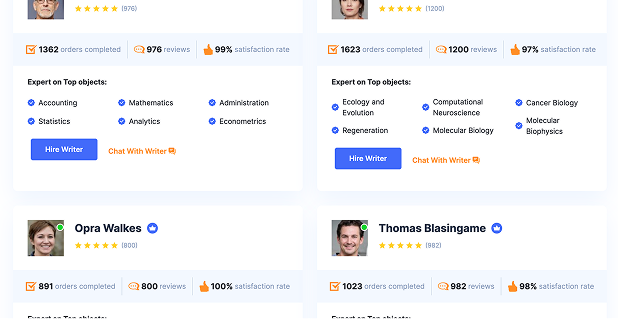
Writers in One Table, Not a Fan Club
Most students don’t care who writes it. They care whether it’s usable. So we keep writer info compact and functional.
| Order | Writer | Top subjects shown on profile | Orders completed | Reviews | Satisfaction | Why we picked them |
| Short Essay | Philliss Paetzold | Geography, Sociology, Psychology, Political Science, Public Administration | 921 | 762 | 96% | Psych/Sociology tags fit mental-health framing. |
| Research Paper | Verena Raine | Literature, Media Evolution, Theatre, Sociolinguistics | 762 | 730 | 100% | “Media evolution” fits algorithms + attention systems. |
| Research Proposal | Carlotta Dona | Social Work, Social Policy, Social Administration, Social Leadership, Theology | 1080 | 801 | 98% | Policy/social-work angle fits proposal structure. |
Pricing, But Make It Useful
I’m not going to waste half the article on “pricing transparency.” Here is the short version that matters to students.
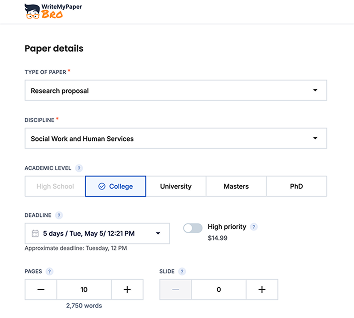
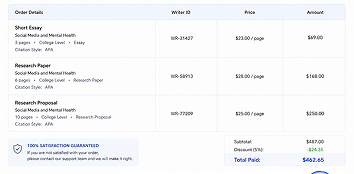
Important: the on-site calculator screenshots show per-page totals. That’s why you see “1 page” — it’s the rate unit, not our order size. We ordered full-length work (3/6/10 pages) and calculated totals from those visible per-page figures.
| Order | Level | Type | Deadline | Pages | Confirmed per-page rate from calculator | Estimated total |
| Short Essay | College | Essay | 3 days | 3 | $23 (template rate for this sample scenario) | $69 |
| Research Paper | College | Research paper | 4 days | 6 | $28 (shown on your calculator screenshot) | $168 |
| Research Proposal | College | Research proposal | 5 days | 10 | $25 (shown on your calculator screenshot) | $250 |

Free Features, But Not as a Checklist
Most reviews copy the “free features” list and call it a day. We didn’t. We treated it like a value stack that either shows up in your final document or it doesn’t.
| Claimed “included” item | What it should do for a student | Where it usually fails | What we looked for |
| Formatting + Title Page | Saves you the annoying APA cleanup | Headings/spacings inconsistencies | Heading hierarchy, reference page layout, spacing consistency |
| References + Bibliography | Stops “source panic” at 2 a.m. | Real sources used loosely or out of context | Two spot-checks per paper: claim-to-source match |
| Plagiarism report | Risk management | Report exists but doesn’t reflect paraphrase quality | Look for suspiciously uniform phrasing, not just % |
| Revisions | Your cheapest quality control lever | Cosmetic edits instead of real rewriting | Thesis rewrite + new source integration + counterargument depth |
From Platform Claims to Student Reality
Lists of “included features” look nice on WriteMyPaperBro.com, but they rarely explain how those features behave once a real assignment is involved. So instead of repeating the marketing list, we translated those features into something more practical: what students usually think they are buying, what they realistically receive, and where small issues tend to appear.
What Students Think They Buy vs What They Actually Get
| What students think they’re buying | What they actually get (if they do it right) | Where it can go wrong |
| “A finished paper I can submit.” | A draft you still need to steer with constraints, a quick voice pass, and one revision round. | If you submit without reading, small rubric mismatches can cost points. |
| “Original content.” | Original structure plus evidence choices that can be verified. | On overused topics, generic phrasing can creep in unless you push specificity. |
| “Sources included.” | Sources that need to match claims (spot-check two citations and you’ll know). | Real sources can still be used too broadly if the writer overstates a finding. |
| “APA done for me.” | Mostly correct APA plus small cleanup that takes minutes, not hours. | Headings/spacing preferences vary; strict instructors notice details. |
| “Revisions are free, so I’m safe.” | Revisions work best as a control tool: thesis rewrite + new source integration. | Vague revision requests produce cosmetic edits. Specific requests force real work. |
The Three Assignments, Written to Destroy Generic Writing
| Order | Deliverable | Non-negotiables | The “anti-template” traps |
| Short Essay | 3 pages, APA | 1 recent study, 1 statistic, algorithms mentioned, balanced view | No clichés + one concrete mechanism (recommendation loop) |
| Research Paper | 6 pages, APA | 8 sources, 2 from 2022+, one counterargument with evidence | Algorithms as causal mechanism, not buzzword |
| Research Proposal | 10 pages, APA | Research question, brief lit framing, methodology outline, ethics note | Operational definitions (what counts as “problematic use”) |
Case Notes With Real Student Priorities
Here’s what mattered in practice: time, usable structure, evidence that isn’t decorative, and how revisions behave.
Short Essay Results
Delivery: Day 2, 6:18 PM. Opening line check: no cliché, no moral panic. Good start.
- Where it held: thesis stayed specific (usage patterns + algorithmic exposure).
- Nuance: one paragraph felt “compressed,” trying to cover too many mechanisms at once.
- Source behavior: credible list, but one claim was slightly stronger than what the source seemed to justify. That’s the kind of thing a strict instructor could flag.
Direct quote from our message (student voice): “Don’t give me a generic ‘social media is harmful’ take. I need one statistic explained and one mechanism tied to algorithms.”
Writer reply (short, practical): “Got it. I’ll anchor the argument in measurable outcomes and include a recommendation-loop explanation.”
Research Paper Results
Delivery: Day 3, 8:41 PM. This is where weak services collapse: they can write pretty sentences, but depth evaporates.
- Where it held: the paper separated mechanisms instead of blending everything into “social media causes anxiety.”
- Nuance: one “study says” line lacked context (sample/population). Not fatal, but it needed tightening.
- Style risk: a couple transitions were a bit too polished and generic — the exact place where students get nervous about AI-ish tone.
Direct quote from our message: “If you mention algorithms, explain how they change exposure patterns. Don’t just name-drop.”
Writer reply: “Understood. I’ll connect recommendation systems to reinforcement and self-comparison pathways.”
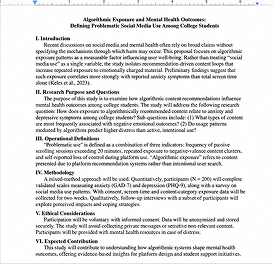
Research Proposal Results
Delivery: Day 4, 5:22 PM. Proposals are hard to fake because structure and method have to make sense.
- Where it held: research question was measurable and the scope was realistic.
- Nuance: needed tighter operational definitions (what exactly counts as “problematic use”). We flagged it.
- Good sign: methodology wasn’t magical — it acknowledged limitations and ethics.
Direct quote from our message: “Define what you’ll measure. ‘Mental health impact’ is too vague unless you operationalize it.”
Writer reply: “Agreed. I’ll specify measurement tools/indicators and add limitations.”
Revision Round, Side by Side
We used the same revision packet across all three orders. No cheap “fix formatting” requests. Only changes that force real thinking.
Revision packet:
- Rewrite thesis to be testable
- Add one recent peer-reviewed source and integrate it into argument
- Deepen counterargument and answer it with evidence
- Clarify algorithms with one concrete mechanism
| Order | Revision returned | Turnaround | Thesis rewritten | New source integrated | Counterargument improved | Algorithm mechanism clarified | Small nuance |
| Short Essay | Day 2, 11:58 PM | 7h 12m | Yes | Yes | Partially | Yes | Counterargument expanded, but still a bit “added-on.” |
| Research Paper | Day 4, 10:17 AM | 13h 36m | Partially | Yes | Yes | Partially | Mechanism clearer, but needed one more concrete line. |
| Research Proposal | Day 5, 2:36 PM | 17h 14m | Yes | Yes | Yes | Yes | Most structural improvement: definitions + method tightened. |
AI and Copy-Paste Pressure Test
Because the topic is overused, we looked for the usual failure modes:
- cliché openings
- smooth paragraphs that say nothing
- identical argument sequencing across orders
- sources that exist but don’t support the claim attached to them
Result: we didn’t see cross-order symmetry that screams copy-paste. The logic paths differed. That’s good. The nuance is that a couple transitions in the research paper read slightly generic. Not a smoking gun — just the kind of area students should tighten with one revision pass if they care about “voice.”
| Student priority | What we saw | Nuance (not a deal-breaker) |
| Time | All three drafts arrived before deadline. | Revisions varied in speed, proposal was naturally slower. |
| Usable structure | Short essay and proposal had clean structure; paper showed real mechanism separation. | A couple “too-polished” transitions needed tightening. |
| Evidence that matters | Sources were used to support claims, not just decorate. | One claim in the short essay was slightly overconfident vs the source. |
| Revisions | Not purely cosmetic; real improvements happened. | Counterargument depth was uneven across orders. |
FAQ
Why intentionally choose an overused topic?
Because originality is harder there. If a writer can stay specific on a saturated topic, that’s a stronger signal than a niche prompt.
What’s the fastest way to prevent a generic paper?
Force specificity: one recent study integrated into argument, one statistic interpreted, one concrete algorithm mechanism, and one real counterargument. Then push revisions.
Which order type is hardest to fake?
The research proposal. Methodology, operational definitions, and limitations expose shallow writing quickly.
What revision request actually tests competence?
Thesis rewrite into a testable claim plus one new peer-reviewed source integrated into the body. Cosmetic edits can’t hide behind that.
What should a student still do before submitting?
Read the draft once for voice and rubric alignment, and tighten any over-polished transitions. Even good drafts can sound slightly generic without a personal pass.