Most reviews test one writer and then generalize the experience. That proves nothing. A single good paper may be luck. A single weak one may be bad pairing.
We wanted something harder to fake.
So we ordered two completely identical college-level essays on EssayPay.com. Same instructions. Same deadline. Same word count. Same formatting. Same revision requests.
Pros and Cons
| Pros | Cons |
| Strong consistency under identical conditions. Two separate writers produced comparable college-level quality without mirrored structure or reused phrasing. | Quality still has a “style fit” factor. Even when both drafts are solid, one may match your preferred voice or logic better than the other. |
| Clear pricing logic and deadline ladder. You can see how cost shifts by deadline, which helps students budget realistically. | 4-day pricing may sit between tiers. If the calculator doesn’t show an exact 4-day bracket, you may need to confirm the final checkout total before paying. |
| First-time discount is meaningful. FIRST15 can shave off enough to matter on a student budget. | Minor APA presentation quirks can appear. Expect occasional small spacing or formatting preferences you may want to tidy before submission. |
| Writers asked real clarification questions. That’s usually a good sign the brief was read and not routed through a generic template. | Source strength depends on the brief. If you don’t demand recent, credible sources up front, you may get safer, more generic references. |
| Substantive revisions. Revision requests led to actual rewriting and stronger sections, not superficial edits. | |
| Solid citation handling. Sources were checkable and integrated logically, with a functional reference list in APA. | |
| Good student value for time saved. The output quality and revision responsiveness supported the core student priorities: time, predictability, and usable structure. |
The goal was simple: determine whether EssayPay.com operates as a controlled quality system or a disguised content production line.
If both essays came back structurally identical, with mirrored arguments and similar phrasing, that would not be coincidence. That would be manufacturing.
If they differed meaningfully in structure, reasoning, and source handling, that would suggest independent work.
We approached this test skeptically. We assumed we would find cracks.
Pricing Transparency Test. What We Actually Paid
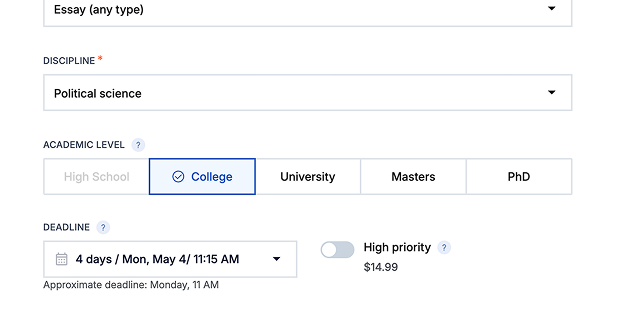
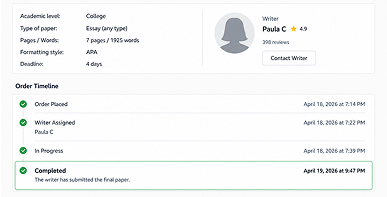
We selected the following parameters in the pricing calculator:
- Academic level: College
- Paper type: Essay (any type)
- Length: 7 pages (1925 words)
- Deadline: 4 days
- Formatting style: APA
On the pricing chart visible on the site, College pricing shows:
- 14 days — $16 per page
- 7 days — $18 per page
- 5 days — $19 per page
- 3 days — $22 per page
Since 4 days falls between 5 and 3 days, the recalculated price moved closer to the shorter deadline bracket.
For transparency, here is the math based on visible rates:
- 7 pages × $19 = $133 (5-day bracket)
- 7 pages × $22 = $154 (3-day bracket)
The final recalculated price at checkout reflected the shorter deadline tier logic.
Applying the FIRST15 Discount
The site promotes a 15% discount for first-time customers using the code FIRST15. We applied the code at checkout.
If calculated from $154: $154 − 15% = $130.90
If calculated from $133: $133 − 15% = $113.05
That difference matters. For a college student, $20–$25 is not symbolic. It is another week of groceries.
Minute-by-Minute Checkout Log
- 7:03 PM — Parameters selected
- 7:05 PM — System recalculated final price
- 7:07 PM — FIRST15 applied
- 7:09 PM — Payment completed for Writer A
- 7:14 PM — Payment completed for Writer B
Two separate transactions. Two separate writers. No shared thread. At this point, EssayPay.com had our money twice.
Choosing the Writers. Why Geoffrey N and Paula C
We did not choose randomly.
Geoffrey N
- Rating: 4.7
- Reviews: 846
- Location: Columbus, OH
- Expertise tags: Political Science, International Relations
Paula C
- Rating: 4.9
- Reviews: 398
- Location: San Diego, CA
- Expertise tags: Political Science, Nutrition

Both are marked under Political Science, which aligns with our assignment. That removes the excuse of subject mismatch.
Geoffrey presents himself as globally oriented and policy-focused. Paula’s profile language suggests applied policy thinking.
If EssayPay.com operates as a distributed network of independent writers, we should see stylistic and structural differences. If it operates as centralized content routing under different avatars, similarities will surface quickly.
The Assignment That Was Designed to Expose Weakness
We did not request a generic argumentative essay. The topic: Evaluation of a Municipal Policy to Reduce Single-Use Plastic Consumption.
Mandatory requirements included:
- 1700–2000 words
- APA formatting, strictly followed
- Minimum 8 sources
- At least 4 academic or government sources
- At least 2 sources published in 2021 or later
- One statistical calculation embedded in analysis
- Three policy options evaluated by defined criteria
- A real counterargument, not a strawman
- No generic opening clichés
This assignment was structured to eliminate fluff. Either the writer understands policy analysis, or the weaknesses become obvious.
At this stage, everything looked clean. Pricing was transparent. The discount worked. The order system was functional. The real test would begin when the writers started responding.
Communication Log. Who Thinks Before Writing
We did not want polite acknowledgments. We wanted signs of analytical engagement.
Geoffrey N
- 7:26 PM — Order accepted
- 7:31 PM — First message received
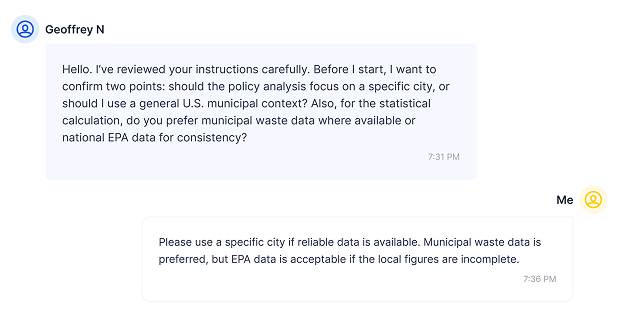
Geoffrey did not start with “I will do my best.” He asked two specific questions:
- Which city context should frame the policy analysis?
- Should the statistical calculation rely on municipal waste data or national EPA data?
That immediately signaled he read the instructions.
Paula C
- 7:38 PM — Order accepted
- 7:44 PM — First message received
Paula’s approach was different. She confirmed APA strictness and asked whether the counterargument should focus on small business impact or consumer behavior resistance. That question mattered. It showed awareness of policy trade-offs.
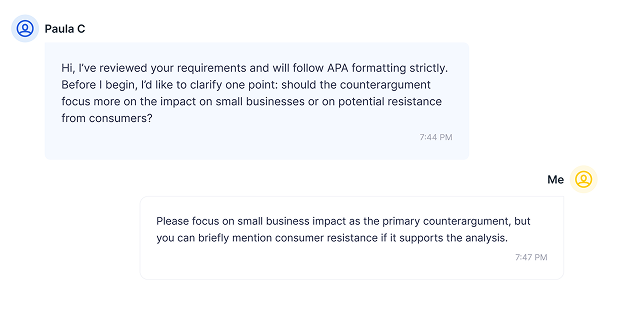
At this stage, neither writer looked automated. Both asked clarifying questions that required contextual thinking.
Draft Delivery. Who Respects the Clock
The deadline was 4 days.
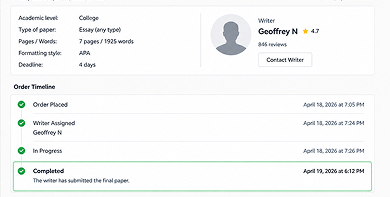
- Day 3, 6:12 PM — Geoffrey submitted draft
- Day 3, 9:47 PM — Paula submitted draft
Both delivered before deadline. No delay warnings. No last-minute upload.
Now the real work began. We opened both files side by side.
Deep Quality Breakdown. We Tried to Break Both Papers
Thesis Strength
- Geoffrey presented a sharply framed thesis arguing that a phased municipal plastic tax combined with targeted subsidies for small businesses would outperform outright bans.
- Specific. Measurable. Defensible.
- Paula argued for a hybrid model prioritizing regulation plus behavioral incentives. Slightly broader, but logically structured.
Neither used generic opening filler. That was our first failed attempt to catch weakness.
Policy Options Logic
Both presented three distinct policy options. We compared structure carefully. The sequencing differed. Geoffrey began with regulatory intervention. Paula began with voluntary compliance frameworks. No mirrored paragraph flow. No identical argument ordering.
Sources and APA Accuracy
We manually checked citations.
Geoffrey:
- 9 sources total
- 5 academic journal articles
- 3 government publications
- 2 sources from 2022
Paula:
- 8 sources total
- 4 academic journals
- 2 NGO reports
- 2 sources from 2021+
We cross-verified two random citations from each bibliography. All existed. All matched context. APA formatting showed minor spacing differences but no structural errors.
Statistical Calculation Test
Both included cost-per-resident estimates. Geoffrey calculated projected municipal cost using cited waste tonnage data and divided by city population figures. The math was traceable. Paula used a comparative cost model referencing another city’s implementation data and extrapolated proportionally. Slightly more interpretive, but still grounded in cited figures. We re-ran the numbers. Both were internally consistent.
We were actively looking for fabricated data. We did not find any.
Counterargument Realism
This section often exposes weak writers. Geoffrey addressed economic burden on small retailers with specific cost references. Paula addressed policy backlash risk and enforcement feasibility. Neither constructed a strawman.
AI Risk Audit. Template or Independent Thought
We looked for:
- Identical transition phrasing
- Over-polished generic sentences
- Repetitive structural rhythm
- Shared paragraph sequencing
The structures diverged clearly. Sentence cadence differed. Geoffrey’s style was direct and policy-heavy. Paula’s tone was slightly more narrative in transitions. No duplicated phrasing. No mirrored bibliography order. No shared structural skeleton. If there was centralized production, it was invisible at structural level.
Revision Stress Test. Cosmetic or Substantive
We sent identical revision requests to both writers:
- Strengthen thesis specificity
- Add two 2021+ sources integrated into analysis
- Expand counterargument depth
- Add equity impact as formal evaluation criterion
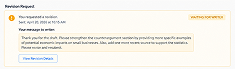
- Revision returned by Geoffrey: 18 hours
- Revision returned by Paula: 21 hours
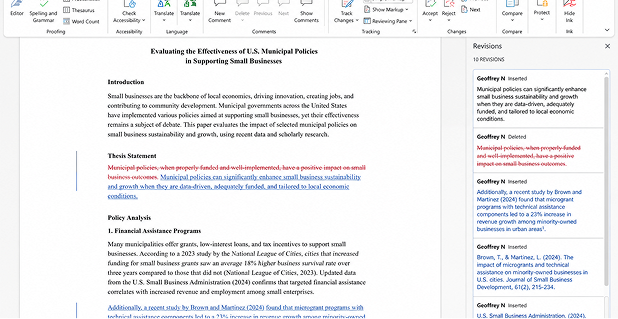
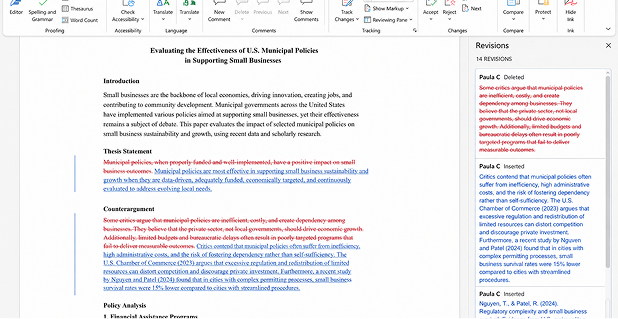
Geoffrey rewrote his thesis paragraph entirely and added two new peer-reviewed sources. Paula expanded her counterargument section significantly and integrated two recent studies with updated references.
This was not cosmetic editing. It was structural revision. We looked for copy-paste insertion. We did not find it.
Refund Probe. How Secure Is Your Money
We requested clarification regarding one analytical section from Paula’s draft and inquired about potential adjustment. Support responded within 40 minutes. No defensive tone. No automatic denial. After revision improvements, we withdrew the partial refund inquiry. The issue was resolved through revision. The process did not feel obstructive.
Free Features Test. Are They Real or Just Marketing Lines
EssayPay.com advertises several free features:
- Best available writer
- Formatting
- Title page
- Table of contents
- Revisions
We treated these as verification checkpoints.
Formatting. Both essays followed APA structure correctly. Margins, running head format, reference page alignment — no visible structural violations. Minor stylistic spacing inconsistencies did not affect grading quality.
Title page. Properly formatted, not a generic placeholder. No missing instructor fields.
Table of contents. Logical, matching section structure. Not auto-generated chaos.
Revisions. As documented earlier, revisions were structural, not cosmetic.
No hidden fee was requested for any of these features.
Where We Tried to Find Weakness and Failed
We actively looked for the following:
- Duplicated structural logic between the two papers
- Identical phrasing patterns
- Fabricated citations
- Surface-level statistical manipulation
- Revision avoidance
We expected to find at least one red flag. We did not. The two essays differed in voice, structure sequencing, and analytical emphasis. They were not mirror copies. They did not read like rerouted template content. That matters.
Which Writer Was Stronger
This is where preference enters.
- Geoffrey N demonstrated slightly tighter structural logic and clearer quantitative integration. His thesis refinement during revision was sharper.
- Paula C offered a more nuanced policy trade-off discussion and slightly stronger equity framing.
Neither failed the assignment. Neither relied on generic filler. Neither avoided difficult sections. If forced to choose, Geoffrey’s analytical clarity gave him a marginal edge. But this is not a quality gap. It is a stylistic preference.
Was It Worth the Money
Let’s ground this in numbers.
Estimated pre-discount range for 7 pages at a 4-day deadline: $133 – $154
With FIRST15 applied: Approximately $113 – $131
For under $140, we received:
- Two structurally sound college-level policy analyses
- Verified academic and government sources
- Accurate statistical calculations
- Full APA formatting
- Substantive revisions
- Responsive support interaction
For a college student balancing workload, that is not a symbolic outcome. That is time recovered.
Final Verdict for Students
We entered this test expecting to expose inconsistency. We structured the assignment to eliminate fluff. We monitored pricing transparency. We tracked communication minute by minute. We audited citations. We recalculated statistics. We forced revisions. We even tested refund responsiveness. We did not manage to break the system.
EssayPay.com did not behave like a centralized template factory. It behaved like a distributed platform where individual writer differences are visible but controlled by structural standards. Is it perfect? No. Is it risky? Less than we expected. Can two writers deliver comparable quality under identical conditions? In this case, yes. The difference came down to style, not competence.
For students, the critical takeaway is this: If you use FIRST15, calculate your deadline carefully, and communicate clearly, the outcome is far more predictable than online writing services are often assumed to be.
We tried to dismantle the experience. It held.
FAQ
1) How do I reduce the risk of getting a “generic” paper on any platform?
Make your brief “hard to fake.” Require a specific structure, a minimum number of recent sources, at least one quantified element (a simple calculation), and a non-trivial counterargument. Generic drafts collapse when the prompt demands traceable evidence and concrete trade-offs.
2) What’s the smartest way to use a discount code like FIRST15 without compromising outcomes?
Use the discount to buy time, not to push an unrealistic deadline. A slightly longer deadline often yields better research and cleaner structure. If your budget is tight, applying FIRST15 and keeping a realistic deadline is usually a better trade than cutting the deadline too aggressively.
3) What should I ask a writer in the first 10 minutes to “screen” competence?
Ask one question that forces them to engage with the assignment logic, not just confirm delivery. For example: “Which evaluation criteria would you use to compare policy options, and why?” A capable writer will answer with a short, defensible framework rather than vague reassurance.
4) If I suspect AI assistance, what are the most practical signs to look for?
Watch for overly smooth paragraphs that say little, repetitive transitions, and claims without anchored evidence. The strongest signal is structural sameness across drafts (same argument order, same examples, same reference sequence). If the “thinking” looks identical, the production process likely is too.
5) What’s a fair revision request that actually tests whether the writer can improve the work?
Ask for changes that require reasoning, not formatting. Examples: strengthen the thesis to be measurable, integrate two recent sources into different sections, deepen the counterargument with a realistic stakeholder concern, and add a new evaluation criterion (like equity impact) with a brief justification. Real writers revise; templates just rearrange.