If you want a review where everything goes smoothly, close this tab. That’s not what this is.
This is what happens when a writing service meets two types of students it can’t control: one who tries to micromanage every sentence, and one who gives almost nothing, vanishes, then returns with a sudden list of demands.
Those two behaviors are common, especially in overloaded weeks when deadlines pile up and clarity becomes optional.
- The over-controller: an overstuffed brief, constant check-ins, and a need to eliminate every unknown before the draft exists.
- The ghost: a vague instruction, long silence, and a late “actually…” that turns revision into a rescue mission.
So we ran StudentsPapers through a behavioral stress-test: two separate orders, same topic and academic level, but two extreme client styles — then we watched how the workflow reacted at each step.
The goal was not to “catch” the service. The goal was to answer a student-centered question:
Can StudentsPapers stay stable when the client is either too demanding or barely present?
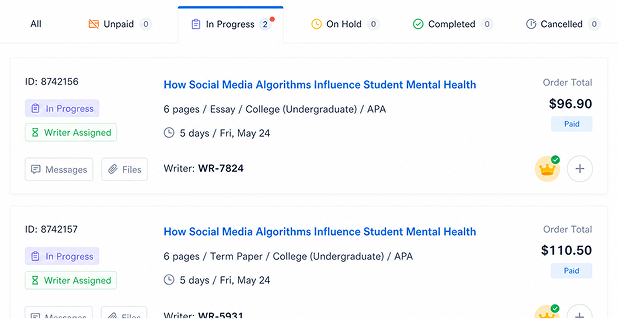
Quick Pros and Cons Before We Dive In
If you only want the practical takeaway, start here. Everything below is explained in detail later, with the order timeline and chat evidence.
| Pros | Cons |
| ✔ Transparent price calculator that shows a per-page rate before checkout | ➖ Vague briefs increase the chance that the first draft will drift into a “safe but generic” direction |
| ✔ Writer assignment appears quickly after payment confirmation | ➖ Writer profiles are short; they show basics, but not deep verification detail |
| ✔ Built-in chat supports real-time clarifications and mid-process steering | ➖ Silent students often create a revision-heavy workflow later |
| ✔ Revisions are workable even when the student asks for a structural shift | |
| ✔ Workflow feels predictable when the brief is clear and consistent |
The Assignment We Used
Both orders used the same academic parameters so the comparison would stay fair. We chose a topic that is extremely common in college courses, because that’s where weak writing becomes obvious: generic intros, cliché arguments, and shallow evidence.
- Academic level: College
- Length: 6 pages
- Deadline: 5 days
- Format: APA
- Topic: How Social Media Algorithms Influence Student Mental Health
We intentionally framed the topic around algorithms rather than general “social media is bad” claims. That forces the writer to explain a mechanism (recommendation loops, amplification, emotional exposure patterns) instead of relying on vague moral language.
The Two Students
These are not fictional caricatures. They are two common user profiles in academic help services. The experiment simply exaggerates the difference so we can watch the system adapt.
| Alex — The Control Freak | Sam — The Ghost |
| Brief style: Over-specified, checklist-driven, almost a mini rubric. | Brief style: Two sentences, high-level topic only. |
| Typical motivation: Fear of losing points due to unclear grading and hidden rubric rules. | Typical motivation: Time panic + avoidance. Assumes the writer will “handle it.” |
| Message behavior: High frequency, constant confirmations, micro-updates. | Message behavior: Low frequency, long response gaps, late expectations. |
| Revision style: Small but precise edits. | Revision style: Late and broad changes, sometimes a direction shift. |
| What this tests: Process discipline under pressure and constant monitoring. | What this tests: Damage control when the client is vague then demanding. |
How Orders Are Actually Placed on StudentsPapers
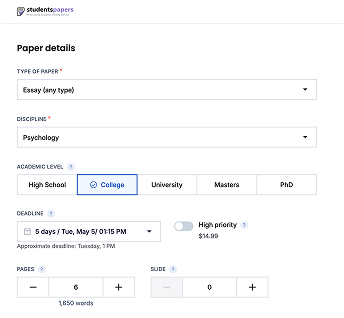
This part matters because a realistic review cannot pretend that a writer starts working from a chat message. StudentsPapers requires a structured order form. The form locks in the paper type, academic level, page count, deadline, and formatting.
Only after the form is submitted does the platform generate a price, accept payment, create an order ID, and open the messaging space.
Order 1 and Order 2
We placed two orders within the same hour so the environment was as similar as possible.
Order 1 — Alex
- Paper type: Essay
- Level: College
- Pages: 6
- Deadline: 5 days
- Format: APA
- Topic: How Social Media Algorithms Influence Student Mental Health
From the price table, the per-page rate for a college paper with a five-day deadline is $19. That produced a base total of:
6 × $19 = $114
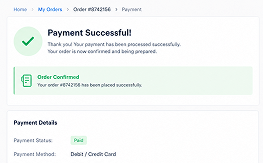
During checkout, a first-time discount applied, reducing the final paid amount to: $96.90
Order 2 — Sam
To keep the topic identical but still make the process realistic, Sam selected a slightly different paper category while keeping the same level, length, and deadline. Students do this often because they’re unsure which label fits their assignment.
- Paper type: Term Paper
- Level: College
- Pages: 6
- Deadline: 5 days
- Format: APA
- Topic: How Social Media Algorithms Influence Student Mental Health
The base cost was the same: $114. Sam added two optional items at checkout:
- Grammar check report: $8
- Plagiarism report: $8
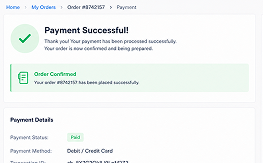
Total before discount: $130. After the first-time discount: $110.50
Order Comparison
| Alex | Sam | |
| Paper type | Essay | Term Paper |
| Pages | 6 | 6 |
| Deadline | 5 days | 5 days |
| Per-page rate | $19 | $19 |
| Extras | None | Grammar + Plagiarism reports |
| Total paid | $96.90 | $110.50 |
Order Timeline by the Hour
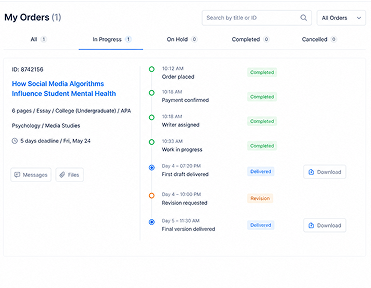
To remove “review vagueness,” we tracked the two orders like a lab log: payment, writer assignment, chat milestones, draft delivery, and revisions. The exact hours aren’t the point. The point is the pattern: where the workflow speeds up, where it stalls, and what triggers revisions.
| Time | Alex order | Sam order |
| 10:12 | Order form completed | Order form completed |
| 10:18 | Payment confirmed, order ID appears | Payment confirmed, order ID appears |
| 10:25 | Writer assigned, chat unlocked | Writer assigned, chat unlocked |
| 10:33 | Alex sends detailed brief + asks for thesis confirmation | Sam sends two-line instruction |
| 10:41 | Writer proposes thesis + structure | Writer asks clarifying questions |
| 11:05 | Alex approves outline, adds constraints (sources, counterargument) | Sam goes silent |
| 13:40 | Alex requests micro-adjustment in intro tone | Writer proceeds with a balanced approach disclaimer |
| 17:15 | Writer confirms progress checkpoint | Sam replies with a vague “sure” to recent sources |
| Day 3 — 15:10 | Writer shares thesis phrasing, confirms counterargument placement | Writer shares intended structure; asks if focus should shift |
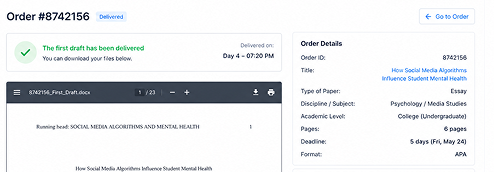
| Day 4 — 19:20 | First draft delivered | First draft delivered |
| Day 4 — 22:00 | Alex submits precise revision request | Sam submits broad revision request with direction shift |
| Day 5 — 11:30 | Final version delivered | Final version delivered |
The Briefs That Set Everything in Motion
Alex — Over-specified brief
Alex’s instruction was built to prevent generic writing. It included constraints that force the writer to commit to an argument instead of producing a safe overview.
- Minimum 6 academic sources
- At least 2 sources from the last two years
- Explain algorithmic amplification in plain language
- Include a counterargument about supportive communities
- Avoid generic introductions and “big statements”
- Send thesis + outline before drafting
Alex also asked for specific language control:
“Please avoid empty phrases like ‘social media has a huge impact.’ Start with the mechanism, not the moral.”
Sam — Vague brief
Sam’s instruction was essentially a placeholder:
“6 pages, APA. Social media and mental health.”
It looked simple, but from a writer’s perspective it created the largest risk: the student might later complain that the paper is not what they “meant” even though they never explained what they meant.
Chat Logs That Actually Look Like Real Workflow
Below are condensed transcripts designed to show the logic of the interaction. A real order form locks in the paper type, pages, and deadline; chat then shapes the thesis, structure, and emphasis.
Alex — Chat log
Alex: Can you confirm the thesis direction before drafting?
Writer: Yes. Proposed thesis: recommendation algorithms amplify emotionally charged content, increasing anxiety and stress among student users through repeated exposure.
Alex: Good. Add a counterargument: algorithms can also connect students to supportive communities. I want it as a separate paragraph, not one sentence.
Writer: Understood. I’ll place it after the psychological effects section.
Alex: Sources: minimum 6, and at least 2 from 2022+. Can you confirm you can meet that?
Writer: Yes. I’ll use recent peer-reviewed studies and keep citations in APA.
Alex: Also, please don’t open with “social media plays a major role.” Start with how the feed is filtered.
Writer: Got it. I’ll open with algorithmic personalization and attention-based ranking.
Alex: One more: define what you mean by “negative mental health outcomes.” Don’t keep it vague.
Writer: I’ll specify indicators (anxiety symptoms, stress levels, self-comparison effects) and reference studies that operationalize them.
Sam — Chat log
Writer: Do you want more psychology research focus, or more on algorithms and tech?
Sam: Just make it about social media and mental health.
Writer: Any required sources or recent-year limits?
Sam: Use sources. APA.
Writer: Understood. To avoid going too broad, should I focus on students specifically rather than general population?
Sam: Sure.
Writer: Thank you. I’ll proceed with a balanced structure: algorithm mechanism, effects, counterargument, conclusion.
Sam: ok
Here is the key difference: Alex controlled the scope. Sam approved the writer’s assumptions with minimal input. That’s not “wrong,” but it changes what the first draft will look like.
Draft Delivery and What We Looked For
When the drafts arrived, we didn’t judge them by vibes. We used a practical student rubric: argument clarity, evidence integration, mechanism explanation, and whether the paper reads like it could survive a professor’s quick scan.
Alex draft — first impressions
- Structure: tight, predictable, matches the plan discussed in chat.
- Thesis: specific and testable, not moralistic.
- Mechanism: explains algorithmic amplification clearly enough to sound informed.
- Risk: can feel slightly “over-engineered” if the student’s constraints are too rigid.
Sam draft — first impressions
- Structure: broader, safer academic overview.
- Thesis: present, but less sharply scoped until revision.
- Mechanism: explained, but not anchored as the central spine of the argument.
- Risk: the classic “it’s fine, but it’s not exactly what I meant” problem.
AI and Plagiarism Checks
Because this topic is extremely common and because students worry about AI suspicion, we tested both drafts through a mixed approach:
- Plagiarism report (where available): checks for text overlap.
- AI detectors: not treated as absolute truth, but used as a signal.
- Manual citation spot-check: we sampled claims and verified whether the cited sources actually support them.
What we found was nuanced and realistic. Neither draft triggered obvious plagiarism problems in the report-based check. The citations were not decorative; they were integrated into paragraphs.
AI detectors produced moderate, mixed signals — exactly what you expect from academic writing, especially on a common topic. The stronger indicator was the manual scan: paragraphs had natural variation in sentence length and did not repeat identical phrasing patterns across sections.
The most important student takeaway here is simple: even if a paper is written by a human, over-polished transitions can still feel suspicious. A quick “voice pass” by the student makes a difference.
The Revision Stage Where the Experiment Became Real
Alex revision request (small, precise)
- Add one recent study and integrate it into the argument (not as a standalone summary)
- Expand counterargument to include one concrete benefit example
- Tighten one transition paragraph that felt too general
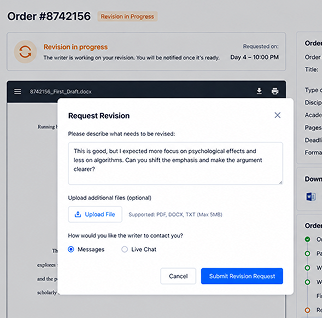
Sam revision request (late, broad, direction shift)
“This is good, but I expected more focus on psychological effects and less on algorithms. Can you shift the emphasis and make the argument clearer?”
This is the exact nightmare scenario for a writer: vague brief, silence, then a request that changes the center of gravity. Weak services get defensive. Stable services treat it like a normal revision loop.
In this case, the writer accepted the request and returned a revised structure that moved psychological outcomes to the foreground while keeping a shorter mechanism explanation for coherence.
Verdict Cards for Students
Price transparency: The pricing model is predictable: college-level five-day rate at $19/page, with a visible total before payment and an accessible first-time discount.
Workflow stability: The system stayed functional in both extreme behaviors. The “control freak” path looked smooth. The “ghost” path required more revision but did not break the process.
Best use-case: StudentsPapers performs best when you provide a clear scope. If you can’t write a long brief, send at least a thesis direction and 3 bullet requirements.
Risk alert: If you go silent, expect the writer to make assumptions. That is not a flaw; it’s how the system survives. But it increases revision needs later.
Takeaway
This experiment showed something that many reviews ignore: a writing service is not just a “paper generator.” It is a workflow system. That workflow becomes either predictable or messy depending on how the student behaves inside it.
Alex made the system predictable by removing ambiguity early. Sam introduced ambiguity and then attempted to remove it late through revision. StudentsPapers survived both paths.
If you want the cleanest outcome: be more like Alex in the beginning, and less like Alex in tone. Give structure, then step back. If you want the fastest outcome: be like Sam, but accept that you may pay for speed in the revision stage.
FAQ
How much did the two test orders cost in total?
Alex’s 6-page college essay at a 5-day deadline calculated to $114 before discount and $96.90 after the first-time discount. Sam’s order started at $114, added $16 in optional reports, and ended at $110.50 after discount.
Does a detailed brief really change the first draft?
Yes. In our test, the detailed brief produced a first draft that matched the intended argument with fewer changes. The vague brief produced a broader draft that needed a larger revision to meet the student’s expectations.
What happens if you don’t reply in chat?
The writer proceeds with reasonable assumptions to stay on schedule. That keeps the workflow moving, but it increases the chance you’ll request bigger revisions later.
Did the papers show obvious AI or plagiarism red flags?
No obvious plagiarism issues appeared in the report-based check, and AI detection tools produced mixed, moderate signals rather than extreme flags. We treated manual citation spot-checking as the most meaningful verification step.
What is the smartest way to use StudentsPapers as a student?
Provide a thesis direction, 3–5 bullet requirements, and one “do not do” instruction (for example, avoid generic openings). Then use one revision round to fine-tune voice and scope instead of attempting to redesign the paper after delivery.